A Tribute to the Google Dictionary Box
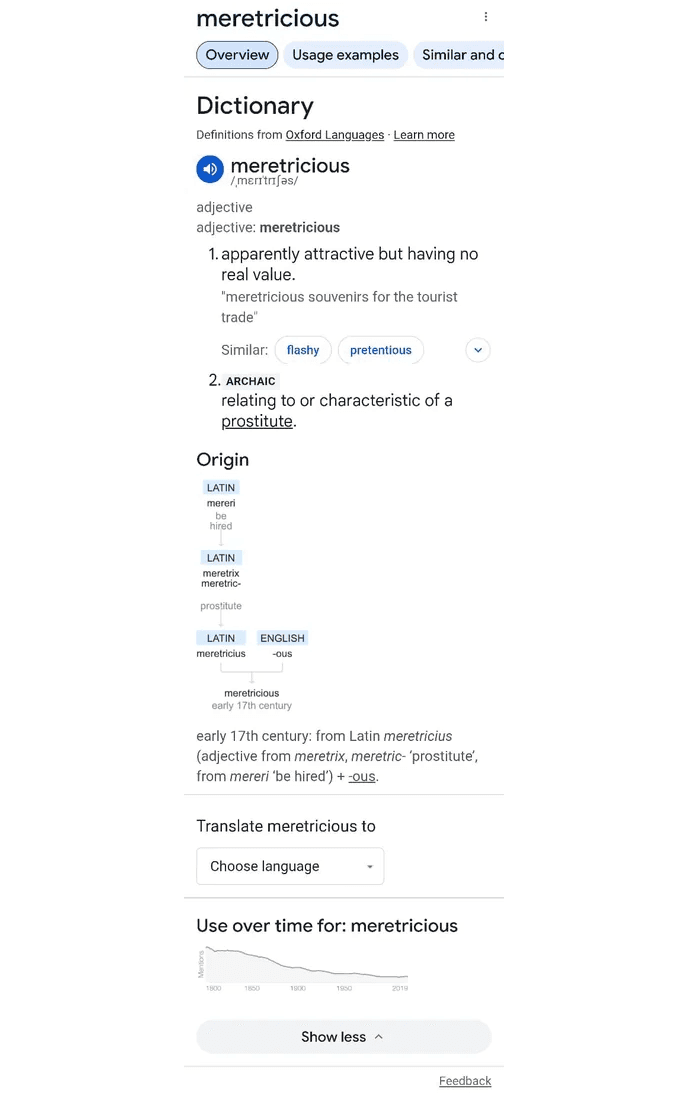
For many years, Google had a "dictionary box" which could be summoned by prepending "define:" to a word of your choosing, and inserting it into the search bar. The results looked something like this:
Now when you search for the definition of a word, you are returned only slop:
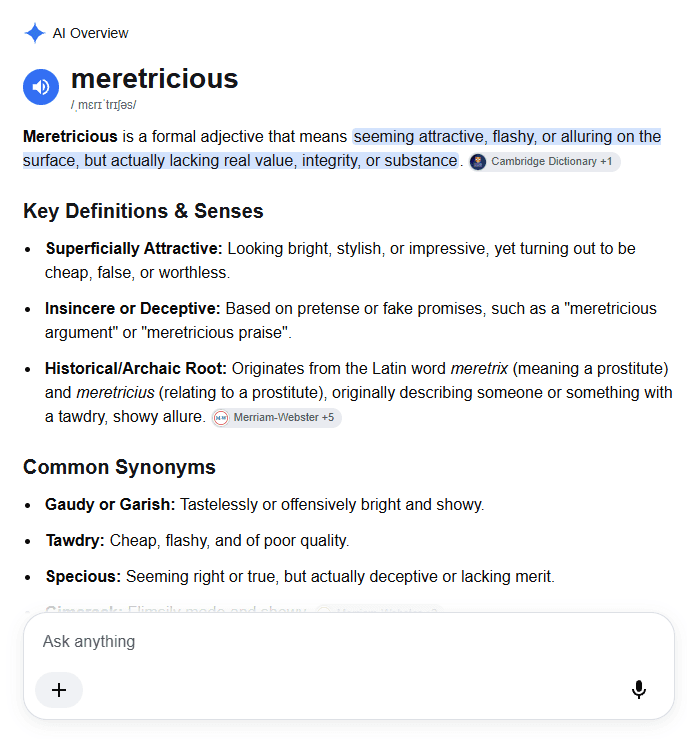
Seems like quite the downgrade doesn't it? I'm not the only person annoyed by this. In my quest to bring back the dictionary box, I found quite the number of complaints, but no workaround to bring back my favourite widget. Inserting "-ai" as a search term removes the replacement AI overview, but doesn't resurrect the dictionary box. 😢
So unless someone at Google kicks up a stink and brings it back, 🪦 RIP to the dictionary box 🪦. I'm not sure what you were called internally at Google, or where your data came from, but my life has been made less efficient and knowledgeable with your disappearance, and I shake my fist at the gradual enshittification1 of Google Search.
Why was the dictionary box so good?
After my initial rage, I tried to figure out exactly why I hate this change.
- The old widget was aestheticly pleasing and well designed.
- It showed more than just the word definition. It showed:
- Phonetic guide
- Synonyms
- Word origin
- Word popularity over time
It also annoys me because I can't just use another search engine - none of them have implemented dictionary widgets either, and going to an actual dictionary website isn't satisfying either because it requires more clicks, and none of THEM have a definition as satisfyingly presented as Google's dictionary widget either.
So I think my main gripe is the horrible aesthetic of the new widget.
What are some plausible reasons for dictionary box assassination?
Initially in the "why I hate this change" section, I wrote this:
Maybe this is just the opinion of someone "pre-AI-era", but I think I like my "definitions" vetted by a human, and not just slopped up ad-hoc.
But the more I think about it, isn't AI almost the perfect tool for dictionary definitions? Language and words have rules and structure, but they're also amorphous and subject to change over time. Word frequency and sentence structure both change over time. So if language is a little "vibe based" why not use the pinnacle humanities' "vibe based" creation, AI, to tell us definitions. As language model weights change, so too will the definitions of words without the need of a dedicated lexicographer to rubber-stamp the changes. If kids make up a new word or phrase, it gets used in training data and automatically gets a definition. Maybe AI is the future of dictionaries?
Oh my, could this change possibly be a good idea?
Or maybe it simply disappeared because it's cheaper? At the top of the old dictionary widget it has the line: "Definitions from Oxford Languages". Maybe Google was paying Oxford for these definitions, and now that AI has scraped all the data required to generate them, Oxford can be thrown aside?
Or maybe we can claim that it's just good old fashioned enshittification and Google doesn't have strong leadership pushing for good products any more? This feels like a bit of a cop-out though, and I'd argue it's probably one of the other reasons.
Conclusion
I'd love to see the aesthetic design of the dictionary widget come back, even if the widget itself remains AI-backed.
Footnotes
-
A tear rolls down my cheek as I search "define:evitability" and accept clanker word as gospel while trying to understand the title of this blog post. ↩